Philip Filipovich Preobrazhensky
The Heart of a DogPhilip Philipovich Preobrazhensky is a prominent professor and surgeon whose transformation experiment makes him creator, investigator, and reluctant guardian of Sharikov. His command of his household and medical work initially seems assured; the experiment’s consequences, however, force him to acknowledge that technical achievement and human formation are not the same thing.
Identity and Introduction
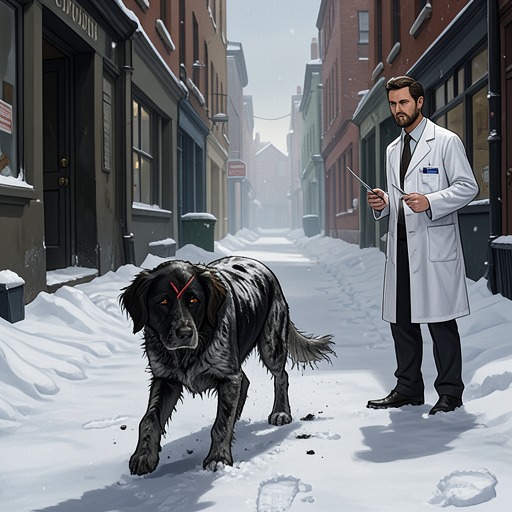
Preobrazhensky first appears as a self-assured gentleman crossing a snowstorm toward a doorway. The narration associates his confidence with the standards he expects for himself: he would not tolerate being served rotten salt beef and would protest publicly if he believed anyone had tried to poison him. His brisk, imperious manner is present before the experiment begins, and helps establish the authority he exercises over both his surroundings and his patients.
He encounters Sharik as a dog and calls to him by that name, then orders Zina to take the animal into the consulting room and bring a white coat. The sequence joins private recognition to professional action: Sharik is not merely offered food or shelter, but brought within the professor’s medical domain. Preobrazhensky’s authority over the dog thus precedes the experiment that will remake the animal’s identity.
The Operation and Its Consequences
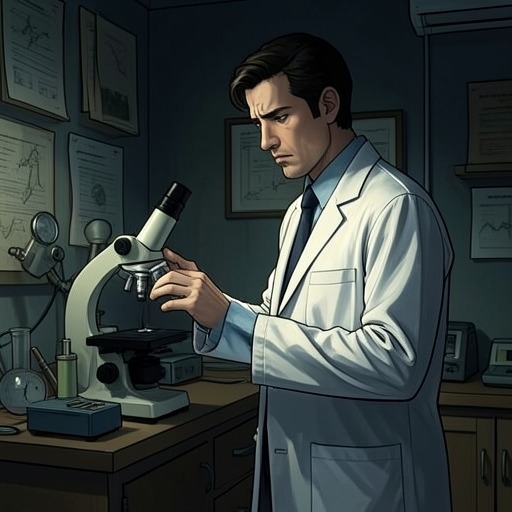
The evidence identifies the experimental subject as a male dog approximately two years old. During the operation, Preobrazhensky directs the procedure while Bormenthal assists. The account presents the work as coordinated medical practice, with the professor making the decisive interventions and his colleague managing the immediate surgical tasks. The scene establishes the experiment’s physical seriousness without making its technical success equivalent to a successful human transformation.
The operation’s consequences reach beyond the consulting room. Rumours spread through the city, attracting onlookers to the street and dogs to the windows. A newspaper report dismisses talk of a Martian in Obukhov Street as unfounded and warns against repeating it, while Preobrazhensky regards the surrounding speculation as a nightmare. The contrast between the extraordinary event and the public’s garbled explanations shows how little control he has over the story once it escapes his household.
Bormenthal’s case notes eventually describe the result as a new organism to be studied in its own right, and mark the end of the case record with his signature and medical title. This clinical framing preserves the experiment as a documented inquiry, but it also signals a limit: the subject is no longer adequately described by the original category of dog, while the notes do not claim that the experiment has produced a stable or satisfactory person.
Naming and Recognition
The transition from dog to human is also a transition in naming. When asked for his name, the transformed figure gives the form Toligraph Poligraphovich. Shvonder then asks what surname he will take and proposes a certificate identifying him as Poligraph Poligraphovich Sharikov, with the flat listed as his birthplace. Preobrazhensky is the professor responsible for the transformation, but the naming and proposed documentation involve other people and institutions as well.
The name therefore acquires a practical force beyond personal address. Sharikov’s registration papers are proposed as a means of establishing who he is and connecting him to the apartment. The name that begins with Sharik, the dog’s familiar designation, becomes part of a formal human identity; the change does not, by itself, resolve the conflict over what that identity means or what obligations follow from it.
Authority, Responsibility, and Conflict
Preobrazhensky’s position combines scientific expertise with domestic authority. When the experiment’s repercussions become evident, he telephones a colleague to cancel an operation and says that he is cancelling his other operations as well, beginning to explain why. The decision connects the unusual case to his wider professional life: the consequences are serious enough to interrupt ordinary work, rather than remain an isolated curiosity.
Later, speaking privately to Bormenthal, Preobrazhensky calls him his first pupil and his friend. He then admits that he mishandled the operation, comparing his performance to that of a third-year medical student. He distinguishes the discovery the procedure produced from the quality of his own work: a remarkable result does not excuse the failure of judgment he believes the operation represents. The admission complicates his earlier image of unshakable mastery, while preserving his willingness to name himself as responsible.
Ending and Narrative Significance
Near the end, a report signed by Sharikov accuses Preobrazhensky of threatening the house committee chairman, making counter-revolutionary speeches, and ordering Zina to burn Engels. The report also alleges that Bormenthal is living in the flat without registration. These accusations turn the household’s conflict into an official political and administrative matter, and show Sharikov using the language of denunciation against the people who created and housed him.
The Moscow Cleansing Department subsequently names Preobrazhensky, Bormenthal, Zina, and Darya among those charged with Sharikov’s murder. Faced with the accusation, Preobrazhensky replies with a regal shrug and claims not to understand who Sharikov is, then identifies him as his dog, the one he operated on. The response sharply separates biological creation from acknowledged personhood: the professor accepts the history of the operation while refusing the identity invoked by the charge. His final position is therefore both a denial and a return to the experiment’s original terms, leaving the boundary between animal, human, and administrative identity unresolved.